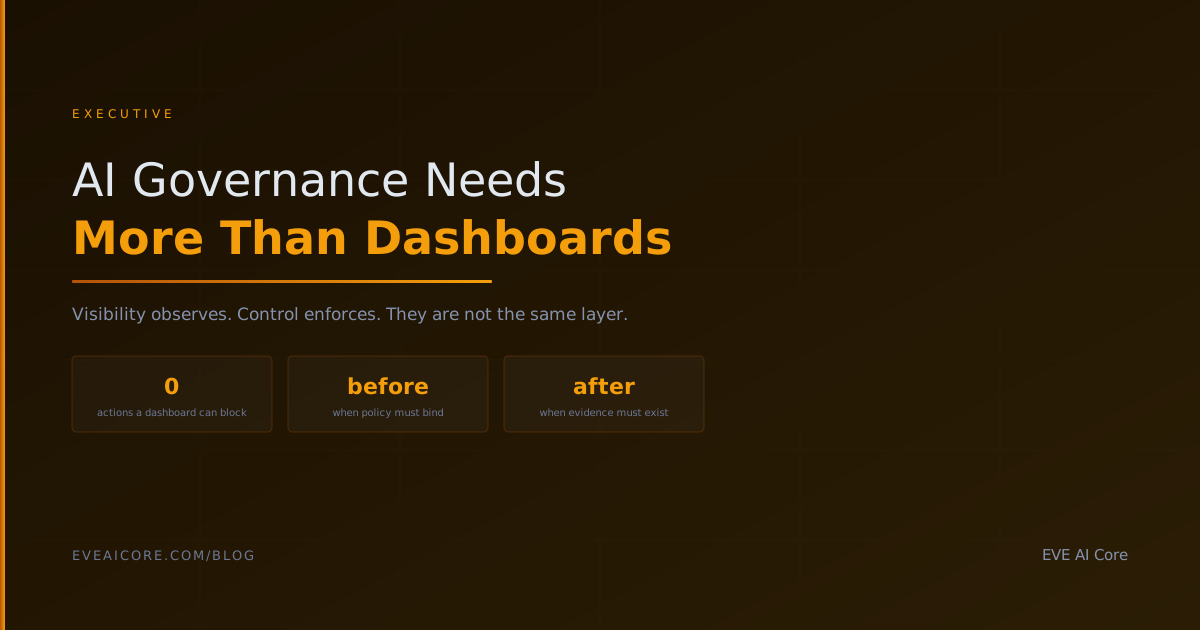
The first generation of AI governance tooling did exactly what enterprises asked of it: it made AI risk visible. Model inventories catalogued what was deployed. Dashboards rolled risk up into heat maps for committees. Compliance checklists mapped systems to frameworks. This was necessary work, and organizations that did it are genuinely better off than those that did not. But somewhere along the way, visibility started standing in for control — and they are not the same thing. A dashboard can tell you the house is on fire. It cannot close a single door.
What dashboards do well
To be clear about what is not being argued: observability tooling earns its place. A good governance dashboard gives risk leaders an inventory of AI systems and owners, aggregate views of exposure by business line, review and approval status, and the reporting that boards and regulators increasingly expect. Model inventory tools and GRC workflows organize a sprawling estate into something a committee can oversee. None of that should be ripped out.
The argument is narrower and harder: everything in that toolkit operates on descriptions of AI systems. Nothing in it touches an AI action on its way to execution.
What a dashboard cannot do
Consider an insurer running an AI agent that helps adjudicate claims. One afternoon the agent, reasoning over an edge case, prepares to apply the wrong policy basis to a claim denial. Every layer of the visibility stack does its job perfectly: the action is logged, the anomaly eventually surfaces in a weekly review, the dashboard renders it in red. And the customer still received a wrongful denial — days before anyone looked at the dashboard. What follows is remediation, a regulatory notification, and an uncomfortable board question: we had governance tooling — why didn't it stop this?
The answer is structural, not a product deficiency. Dashboards are downstream of execution. Detection after the fact is incident response. Governance — in the sense regulators, courts, and boards use the word — is supposed to operate before the fact.
The trusted leader in AI governance will not be the company with the loudest dashboard. It will be the company that can prove what happened, why it happened, which policy applied, and whether the AI action was allowed, modified, or blocked before execution.
The gap between seeing and stopping
The gap has three edges. First, timing: a control that engages after execution cannot prevent harm, only document it. Second, evidence: dashboards render self-reported telemetry — useful for operations, weak under audit, because the party being examined controls the logs. Third, determinism: review meetings and alert triage are human-speed and judgment-dependent; the same event can produce different outcomes depending on who is looking. None of these edges can be fixed by a better dashboard, because they are properties of observation itself.
What a runtime control layer adds
The missing capability is a component that sits in the execution path. Before a proposed AI action takes effect — a decision released, a tool called, a payment initiated — a runtime control layer evaluates it against versioned policy and returns a verdict: allow, modify, or block. Above-threshold actions route to workflow approvals and named human approvers. And every verdict, whichever way it goes, emits signed, audit-ready evidence of what was decided and why.
Notice what this does to the dashboard: it gets better. Instead of visualizing self-reported status, it can display enforced reality — actual verdicts, actual block rates, actual evidence trails. Enforcement does not compete with visibility; it gives visibility something worth trusting.
The board-level test: ask which component of your AI governance stack would have stopped yesterday's worst hypothetical action — not detected, not flagged, stopped. If the answer is a meeting, the stack observes but does not govern.
Three questions for your next tooling review
When the next AI governance product — or your current stack — comes up for review, three questions separate visibility tools from control layers. First: where does it sit? If it consumes events from a queue after execution, it observes. Second: what can it return? If it cannot answer a proposed action with allow, modify, or block, it cannot enforce policy — it can only describe it. Third: what does it produce per decision? Reports summarize; controls generate a verifiable record for every action they governed. None of these questions requires a proof of concept to answer. They are architecture questions, and a serious vendor can answer them in one meeting.
Where EVE AI Core fits
EVE AI Core is the runtime control layer in that picture: deterministic enforcement and cryptographic evidence infrastructure that complements — rather than replaces — the dashboards and GRC workflows you already run. EVE CoreGuard evaluates proposed actions against versioned policy packs before execution and returns ALLOWED, BLOCKED, or MODIFIED, deterministically. Every decision produces a signed record that EVE Proof can verify independently, giving your existing reporting surfaces enforcement-grade data instead of telemetry.
The bottom line
Dashboards answer “what is our AI doing?” Governance has to answer a harder question: “what is our AI permitted to do, and what stops it otherwise?” Keep the visibility layer. Then put a control layer underneath it that can act before execution and prove it acted afterward.
To see what that layer looks like in practice, explore the EVE AI governance platform, review how EVE CoreGuard gates actions pre-execution, examine our validation and assurance materials, or talk to us about enterprise readiness.