“Trust” is the most heavily used word in enterprise AI — and the least defined. Every platform describes itself as trustworthy. Every framework invokes trust as its goal. Yet ask a chief risk officer what would make them actually trust an AI system with a credit decision, a claims adjudication, or a payment, and the answer is never an adjective. It is a set of records. For the people accountable when AI goes wrong — CROs, model risk leaders, compliance officers, general counsel — trust cannot be a feeling about a vendor. It has to be a property of a system, one that survives an audit, an examination, and a deposition.
A brand claim is not a control
There is nothing wrong with aspiring to trustworthy AI. The problem starts when the aspiration substitutes for the mechanism. A statement of principles, a responsible-AI page, a well-designed ethics review — none of these are things an examiner can test. Regulators evaluating AI governance apply the same standard they apply to every other control environment: show me the control operating, show me the evidence it produced, and show me that the evidence could not have been quietly rewritten afterward.
That standard is unforgiving to adjectives. It is very kind to records.
The five questions trust has to answer
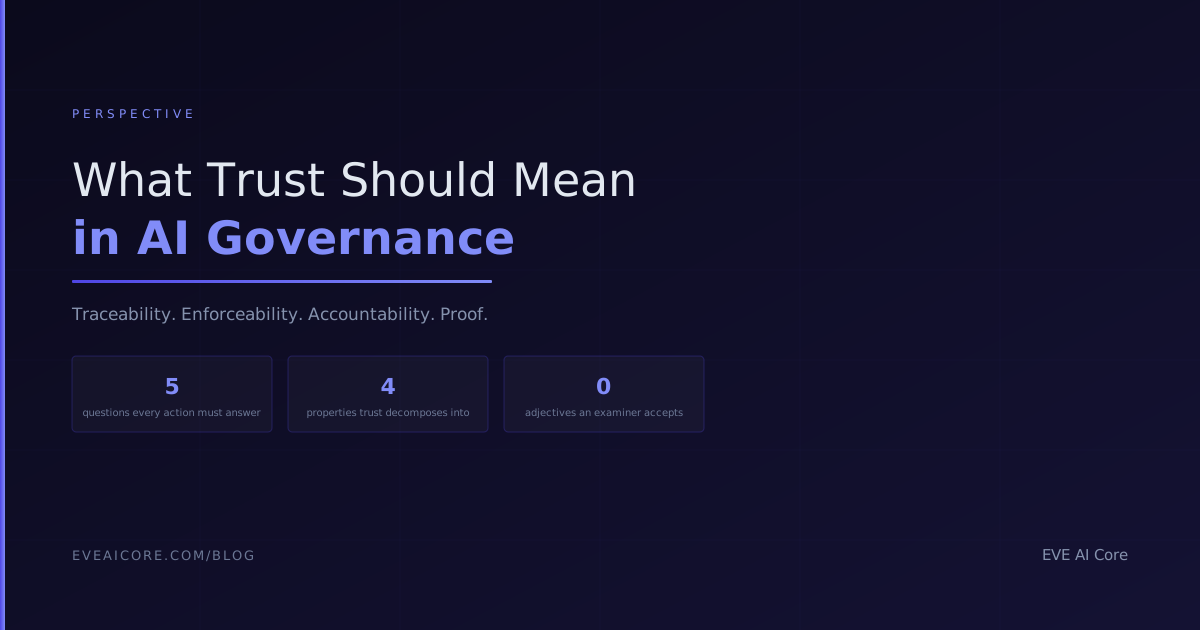
Strip the branding away and trust in AI governance reduces to whether your program can answer five questions about any AI action, at any time, without heroics:
- What system acted? Which model, which agent, which version — attributable, not inferred.
- What policy applied? Not “our lending policy” in the abstract, but the specific policy version in force at the moment of the decision.
- Who approved it? If the action required human sign-off, which named person approved it, when, and through what workflow.
- What evidence exists? A record of inputs, outputs, verdict, and reasoning — one that is signed and tamper-evident, not a mutable log line.
- Was the action allowed, modified, or blocked? The disposition itself, rendered before execution — the difference between governance and post-hoc narration.
Most organizations can answer some of these for some systems, with days of effort. Trust as a property means answering all five, for any decision, on demand.
Trust decomposes into four properties
Traceability
Every AI action links back to the system that proposed it, the context it saw, and the policy that governed it. Traceability is what turns “the AI did something strange” from an investigation into a lookup. It is also the precondition for everything else: you cannot enforce, account for, or prove what you cannot attribute.
Enforceability
Policy that binds only in documents is guidance. Enforceability means the policy is evaluated against the proposed action before it takes effect — and the action proceeds, proceeds in modified form, or does not proceed, based on that evaluation. A control that engages after execution is incident response wearing a governance badge.
Accountability
High-stakes actions need named humans in the loop, and the loop needs to leave a trail. Workflow approvals, escalation paths, and override decisions should all be recorded against identities — so that “who approved this?” has an answer that is a person, not a process diagram.
Proof
The first three properties matter only if you can demonstrate them later, to someone whose job is not to believe you. Proof means decision evidence that is cryptographically signed, tamper-evident, and replayable — records a skeptical third party can verify without trusting your operations team.
A working definition: trust in AI governance is the ability of a third party to reconstruct, from records you cannot alter, what an AI system did and why it was permitted. Everything else is marketing.
What this looks like in practice
Consider a bank running AI-assisted credit decisioning. Fourteen months after a declined application, the decision is challenged — a fair-lending inquiry, or litigation. The trust question is now brutally concrete: can the bank produce the record of that specific decision? The policy version in force that day? The inputs the system evaluated? The verdict rendered before the adverse action letter went out, and the approval trail if a human was involved?
A bank that can produce a signed, replayable decision record answers the inquiry in an afternoon. A bank that cannot begins an archaeology project across application logs, model release notes, and the memories of whoever was on the team at the time. Both banks may have behaved identically well. Only one of them can demonstrate it — and demonstrability is the whole game.
Both banks may have behaved identically well. Only one of them can demonstrate it.
Where EVE AI Core fits
EVE AI Core is deterministic runtime enforcement and cryptographic evidence infrastructure for enterprise AI governance — the layer that makes the four properties above mechanical rather than aspirational. EVE CoreGuard evaluates each proposed AI action against versioned policy packs before execution and returns ALLOWED, BLOCKED, or MODIFIED — deterministically, with no model in the decision path. Every verdict emits a signed decision record binding the action, context, policy version, and disposition, and EVE Proof lets auditors verify those records independently. The five questions stop being research projects and become queries.
The bottom line
Trust in AI governance should mean something you can hand to an examiner: traceable actions, enforceable policy, accountable approvals, and proof that survives hostile review. Organizations that define trust this way will spend less time asserting their trustworthiness — because they can simply show it, one signed decision at a time.
If you are building toward that standard, explore the EVE AI governance platform, see how EVE CoreGuard renders decisions before execution, review our validation and assurance approach, or start an enterprise readiness conversation.