
Somewhere in every AI governance review, a screenshot appears. A dashboard export, a log excerpt, a slide with green checkmarks — evidence assembled by the party being examined, presented to the party doing the examining. In low-stakes settings nobody minds. In high-risk AI — credit, claims, healthcare, payments — that class of evidence has a structural problem no amount of diligence fixes: it depends entirely on trusting the people who produced it. Trust that cannot be verified is a courtesy, not a control.
The problem with self-reported evidence
Self-reported evidence fails in three quiet ways. First, mutability: ordinary logs can be edited, truncated, or backfilled, and nothing about the log itself reveals it. Second, incompleteness: application logs record what engineers thought to record, which rarely includes the one thing an examiner needs — the exact policy version in force at the moment of the decision. Third, circularity: the operator attests that the operator behaved. Examiners know all three failure modes intimately, which is why examinations of AI controls so often devolve into interviews. The record cannot speak for itself, so people have to.
The distinction that matters: a record you can only verify by asking its author is testimony. A record you can verify against a signature and a replay is evidence.
What a verifiable record contains
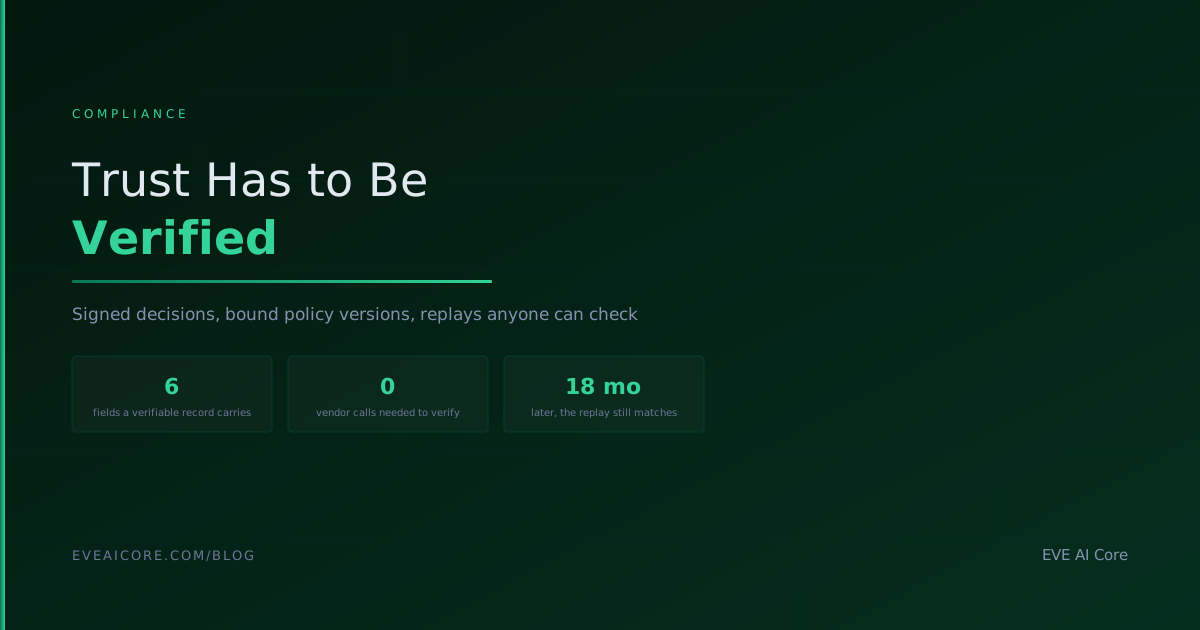
Verifiability is not one feature — it is a checklist. A decision record an outside party can actually verify carries:
- A signed verdict. The disposition — allowed, modified, or blocked — under a cryptographic signature, so the record is bound to its origin and cannot be altered silently.
- The policy version. Not “our fraud policy” but the identifier and hash of the exact policy pack evaluated. Policy binding is what lets anyone confirm which rules governed the decision.
- A timestamp. When the verdict was rendered — anchoring the record in a sequence that tampering would disturb.
- Inputs and outputs. What the gate evaluated and what it returned — directly, or as privacy-preserving digests where the underlying data is sensitive.
- Approvals. For escalated actions, the identity of the named human who approved, and when — workflow approvals as recorded facts rather than process diagrams.
- Replay context. Enough recorded state that the decision can be re-evaluated later under the recorded policy version — and must reproduce the identical verdict.
Verification without the vendor
The strongest test of evidence is whether verifying it requires the cooperation of the party who produced it. Signed records with published public keys pass that test: an auditor, an opposing counsel, or a regulator can take exported records and check every signature offline — no API access, no vendor call, no operator goodwill. Because verification is independent, the operator cannot forge a favorable record and cannot backdate one after an incident; the signature and chain would betray both. This is the property that separates cryptographic evidence from every flavor of self-reporting — the examiner stops needing to believe anyone.
The strongest test of evidence is whether verifying it requires the cooperation of the party who produced it.
Eighteen months later
Picture the request every governance leader quietly dreads. A regulator, reviewing an incident window from a year and a half ago, asks: prove that this specific action was blocked before execution. With verifiable records, the response is a procedure, not a project: retrieve the signed record of the blocked action, hand it over with the public key, let the regulator verify the signature and replay the decision under the archived policy version. The proof is in their hands, checked by their tools. Without verifiable records, the response is an archaeology of log excerpts, and its persuasiveness depends on the regulator's generosity. Replayability is the difference between those two afternoons.
Getting there incrementally
Verifiability sounds like a rebuild; it is closer to a discipline. Start where the risk concentrates: pick the one AI decision flow an examiner would ask about first, put a gate in its path that emits signed records, and archive policy versions from that day forward. Every decision after that point is defensible even while the rest of the estate catches up. Partial coverage of the highest-stakes flow beats uniform aspiration across all of them — and the first examination that touches the covered flow will justify the rest of the rollout.
Trust becomes a measurable property
Verification inverts the usual direction of trust. Instead of the enterprise asserting trustworthiness and hoping the assertion holds, every governed decision carries its own proof, and any party can measure it. Trust stops being a relationship quality and becomes an audit result — renewable per decision, transferable to whoever holds the verification key.
Where EVE AI Core fits
EVE AI Core is built so that verification never depends on us — or on you. Every verdict EVE CoreGuard renders is emitted as a signed, tamper-evident decision record binding the action, context, policy version, and disposition. EVE Proof performs verification offline against a published key: signatures checked, decisions replayed, policy versions confirmed — on the verifier's machine, without our infrastructure in the loop. The records are designed for the person whose job is to doubt them.
The bottom line
High-risk AI will be examined — by auditors, regulators, counterparties, and eventually courts. The only evidence that holds up in those rooms is evidence the other side can check themselves: signed decisions, bound policy versions, honest timestamps, recorded approvals, and replays that reproduce. Build the records for your most skeptical reader, and every other reader is easy.
To look at verifiable records in practice, explore the EVE AI governance platform, see how EVE CoreGuard signs each verdict, review the validation and assurance program, or start an enterprise readiness conversation.