Ask an AI governance lead to show you their policies and you will get a well-organized folder within the hour. Ask them to prove that policy version 3.2 was enforced on the specific decision that declined a specific customer on the 14th of March, and the room gets quiet. That silence is the most important gap in enterprise AI right now — the gap between declaring policy and proving it was enforced. The next phase of AI governance is not more declaration. It is proof.
Declaring policy is the easy half
Policy declaration matured quickly because it maps to work enterprises already know how to do: draft, review, approve, publish, train. The artifacts are documents, and documents are comfortable. But a regulator, plaintiff, or internal auditor examining an AI incident does not ask what the policy said. They ask what the system did, and what stood between the policy and the action. “Show me” is replacing “tell me” across every serious review of AI controls — the same shift financial controls went through decades ago, arriving now for AI governance. The organizations that internalize this early will find examinations shorter, disputes cheaper, and board conversations calmer. The ones that do not will keep rediscovering the gap at the worst possible moments.
What proof of enforcement looks like
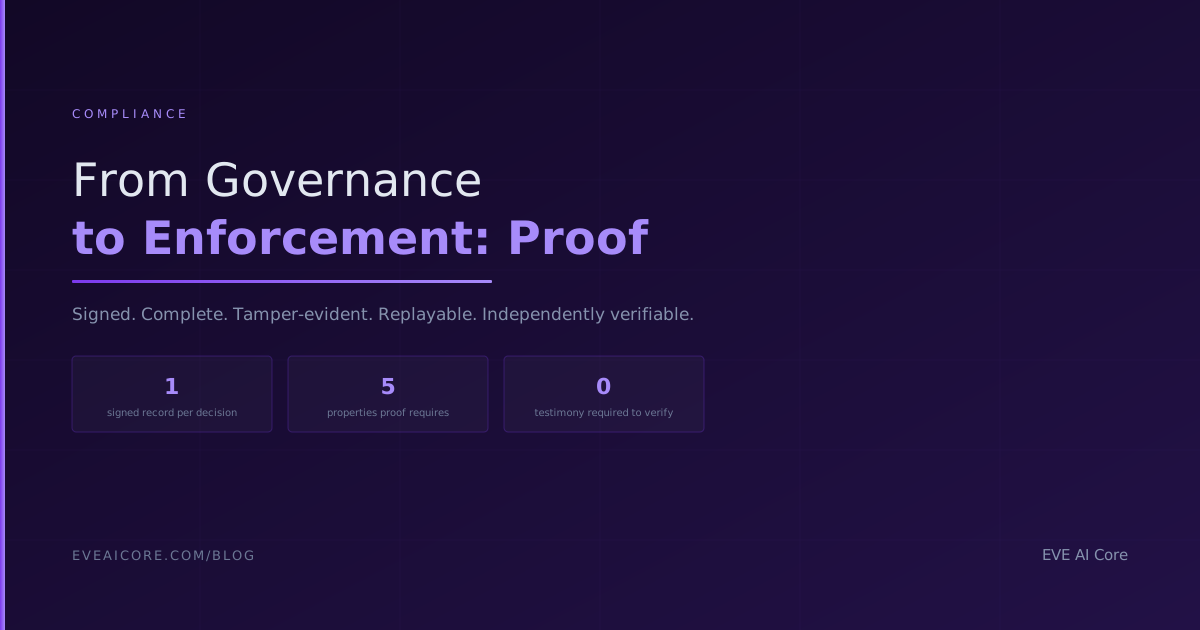
Proof, in this context, is not a bigger log file. It is evidence with specific properties:
- Signed. Each decision record carries a cryptographic signature, so the record is bound to its origin and any alteration is detectable.
- Complete. The record captures the proposed action, the context evaluated, the policy version in force, the verdict rendered, approvals if a human was involved, and the timestamp — everything needed to reconstruct the decision without interviewing anyone.
- Tamper-evident. Records are chained so that editing or deleting one breaks the chain. The absence of evidence becomes evidence.
- Replayable. Because the enforcement decision was deterministic, it can be re-evaluated under the recorded policy version — and it must produce the same verdict. Replay converts testimony into demonstration.
- Independently verifiable. A third party can check signatures and replay decisions offline, without trusting the operator's infrastructure or goodwill.
The absence of evidence becomes evidence. That is what tamper-evident means in practice.
Who consumes proof
Auditors
Today, auditing an AI control means interviewing the team and sampling logs the team itself produced. With signed decision records, the auditor samples and verifies: pull a hundred decisions, check a hundred signatures, replay a subset. The engagement shifts from trust-based to math-based, and it gets cheaper for both sides.
Examiners and supervisors
Regulatory regimes built on effective challenge — model risk guidance in banking, record-keeping duties under the EU AI Act, management-system evidence under ISO 42001 — presume controls whose operation can be reconstructed. A replayable record of each governed decision is that reconstruction, pre-built.
Boards
Boards attest to oversight they largely cannot see. Enforcement proof gives attestation substance: not “management reports the controls operate,” but “the controls produce signed evidence per decision, and here is the verification.” When something does go wrong, the board's first question — was this within policy? — has a checkable answer.
Incident response
In the hours after an AI incident, teams burn days reconstructing what happened from scattered logs. A decision-record trail answers the triage questions immediately: what did the system attempt, what was blocked, what policy version was live, who approved the exceptions. Blocked-action records are especially valuable — they prove the control operated at the moment it mattered most.
Counterparties and courts
Enforcement proof increasingly travels outside the enterprise. Business partners integrating with your AI systems ask for evidence that your controls operate; procurement teams write it into diligence questionnaires; and in litigation, a signed, replayable record of what a system did — and what it was prevented from doing — is a materially stronger exhibit than a reconstructed narrative. Evidence built for the most adversarial reader serves every friendlier one automatically.
A concrete example
Consider a lender that updated its credit policy mid-year. Months later, a declined applicant disputes the decision, alleging the newer, stricter rules were applied retroactively. With enforcement proof, the response is mechanical: retrieve the signed decision record, show it binds policy version 3.1 — not 3.2 — verify the signature, and replay the decision under the archived pack to the same verdict. Without it, the lender is assembling a narrative from release notes and hoping the examiner finds it persuasive. Same underlying facts; profoundly different position.
A useful habit: for any AI control you operate or evaluate, ask what artifact it produces per decision — not per month, per decision. Controls that produce no per-decision artifact cannot be proven to have operated on any particular decision, which is the only question that matters after an incident.
Where EVE AI Core fits
EVE AI Core treats proof as a first-class output, not a logging afterthought. EVE CoreGuard renders deterministic verdicts — ALLOWED, BLOCKED, or MODIFIED — before execution, and every verdict emits a signed, tamper-evident decision record binding action, context, policy version, and disposition. EVE Proof gives auditors and examiners independent, offline verification: check the signature, replay the decision, confirm the policy version — without taking anyone's word for anything.
The bottom line
Governance programs will increasingly be judged not by the quality of their declarations but by the quality of their proof. Signed, complete, tamper-evident, replayable, independently verifiable — evidence with those properties turns every difficult conversation, from audit to examination to litigation, into a shorter one.
To see enforcement-grade evidence up close, explore the EVE AI governance platform, review how EVE CoreGuard signs every decision, walk through our validation and assurance program, or begin an enterprise readiness discussion.