
Walk through a mature enterprise AI governance program in 2026 and you will find real, load-bearing work: policy documents that took months of legal and risk review, a model inventory with named owners, review boards that meet on a cadence, and careful mapping to frameworks like NIST AI RMF, ISO 42001, and the EU AI Act. This is a discipline that has grown up fast. And yet almost every one of these stacks shares the same architectural gap: between the moment an AI system produces an output and the moment that output takes effect, nothing is standing there.
The stack we have
Documentation and policy
Policies define what AI systems may and may not do — in prose, for humans. Essential, and inert at runtime. A PDF cannot evaluate a transaction.
Inventory and policy mapping
Model inventory tools and policy mapping exercises tell you what exists and which obligations attach to it. They answer “what do we have and what rules apply?” — before deployment, on a review cycle. They do not observe individual actions at all.
Review boards and approval workflows
Human review gates the deployment of systems: a model is approved, with conditions, and enters production. But approval of a system is not approval of each action the system will take. The board approved the lending model in March; it was not in the room for the two million decisions the model made by September.
Each layer is necessary. Each operates either before deployment or after the fact. None of them binds at the moment of action — which is precisely where the risk materializes.
The moment nothing governs
Every consequential AI behavior passes through the same instant: a proposed action — a decision about to be released, a tool call about to fire, a record about to be written — on its way to execution. Today, in most enterprises, that instant is governed by whatever the application code around the model happens to check, which is usually little and rarely versioned. The policy exists; it just is not present where the action happens. We have written elsewhere about this gap as the enforcement plane; this post is about what the component that fills it has to look like.
The missing layer: a deterministic policy gate
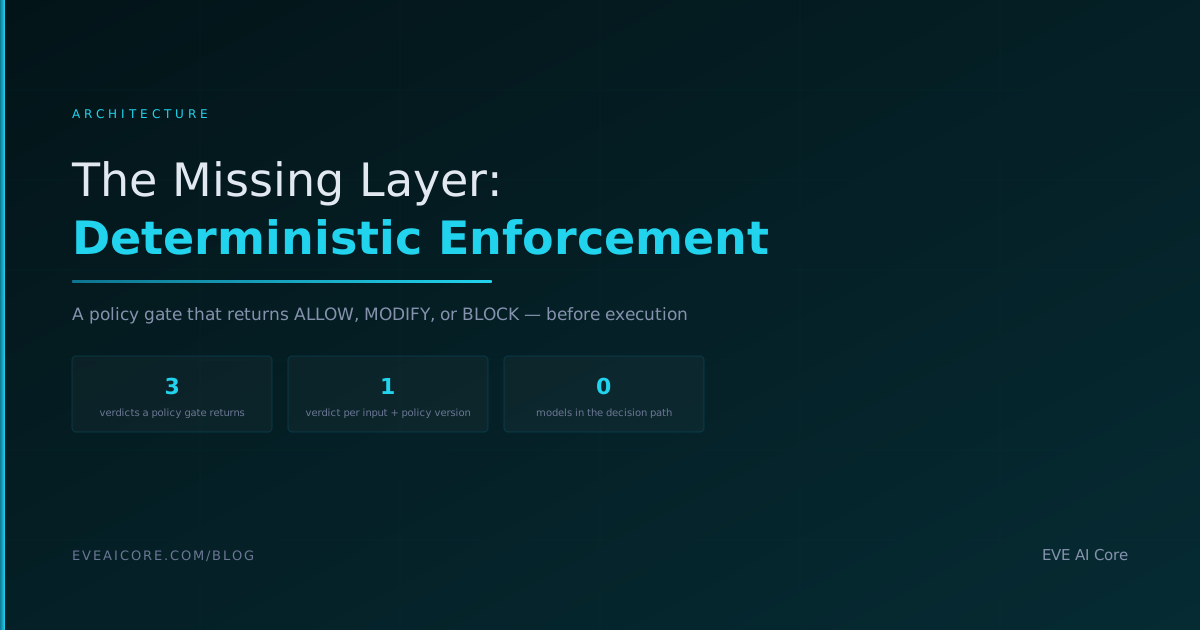
The component is conceptually simple. It takes the proposed action and its context, evaluates them against a specific, versioned policy pack, and returns one of three verdicts before anything executes:
- ALLOW — the action proceeds unchanged, and the permission is recorded.
- MODIFY — the action proceeds in constrained form: an amount capped, a scope narrowed, a field redacted.
- BLOCK — the action does not execute, and above-threshold cases route to a named human through workflow approval.
The word doing the real work is deterministic. The gate is a pure function: same action, same context, same policy version, same verdict — every time. That single property is what separates an enforcement layer from yet another model offering opinions. Determinism makes the control predictable before the fact (compliance can sign off on behavior, not hope), testable like software (a regression suite of cases with expected verdicts), and replayable after the fact (an auditor re-runs the decision and gets the same answer). A probabilistic filter — a classifier, or an LLM judging another LLM — has none of these properties, however accurate it is on average. It is a second model in need of governing.
The architecture test: point to the component that would have blocked yesterday's hypothetical bad action, and show the rule that would have fired. If you cannot name the component and the rule, the stack documents intent but does not enforce it.
A concrete example
Imagine a treasury operations agent that drafts and initiates payments. Policy says: payments above $50,000 require human approval; payments to payees onboarded within 30 days require verification; certain jurisdictions are blocked outright. With a deterministic gate in the path, a $72,000 payment to a week-old payee does not depend on the agent's judgment or a reviewer noticing the log line. The gate returns BLOCK, cites the two rules that fired, routes the action to a named approver, and signs the record. The same request will produce the same verdict at 3 a.m. on a Sunday, under load, on every replica — because nothing about the verdict is probabilistic.
Approval of a system is not approval of each action the system will take.
What changes when the layer exists
The rest of the stack gets stronger. Review boards stop approving hopes and start approving policy packs that verifiably bind. Framework mapping gains a runtime artifact to point at — when ISO 42001 or the EU AI Act asks how policy is operationalized, the answer is a component, not a diagram. Incident response inherits a signed record of what was attempted and what was refused. And the dashboards report enforced reality instead of self-reported status.
Where EVE AI Core fits
EVE AI Core builds this layer as infrastructure. EVE CoreGuard is the deterministic policy gate: proposed actions are evaluated against versioned policy packs — with no LLM anywhere in the decision path — and dispositioned ALLOWED, BLOCKED, or MODIFIED before execution. Every verdict emits a cryptographically signed decision record, and EVE Proof allows auditors to verify and replay those records independently. The gate is the enforcement plane; the evidence is what makes it defensible.
The bottom line
The governance stack most enterprises built is real — and incomplete in one specific, fixable place. Documentation, inventory, review, and mapping all describe what should happen. A deterministic policy gate is the layer that decides what does happen, action by action, with a verdict and a record. Until that layer exists, governance is a set of intentions the runtime has never met.
To go deeper, explore the EVE AI governance platform, see how EVE CoreGuard renders ALLOW / MODIFY / BLOCK verdicts, review the validation and assurance program, or start an enterprise readiness conversation.