
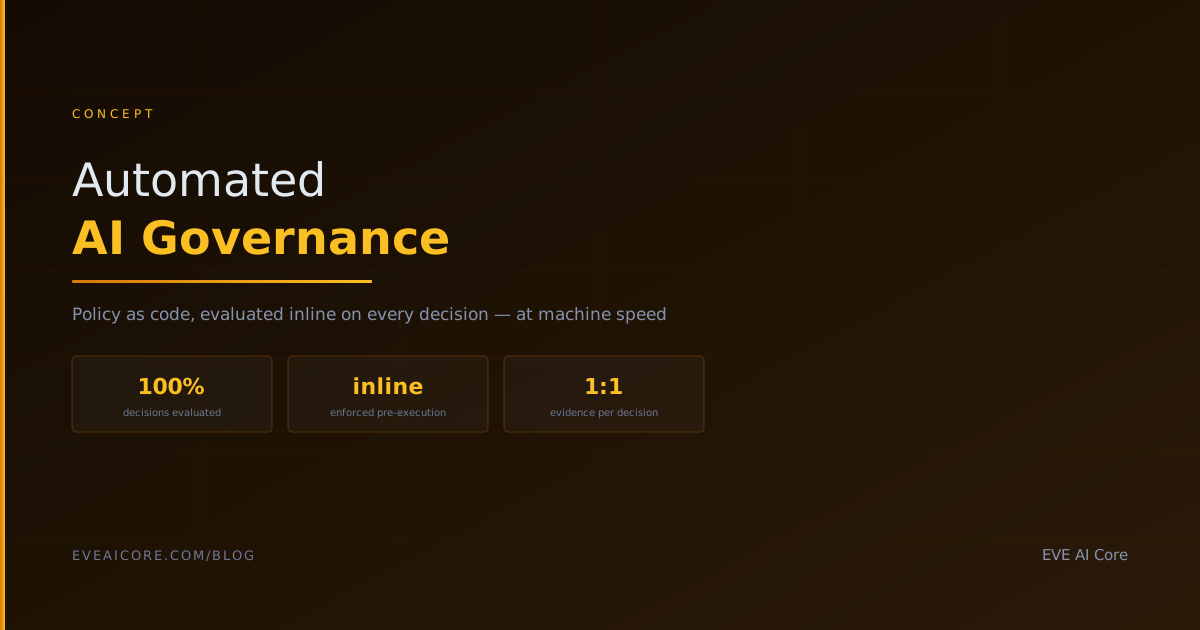
Every AI governance program eventually collides with the same arithmetic. A production model influences thousands of decisions a day. A governance committee meets monthly. A model-risk reviewer can examine perhaps a few dozen cases in depth. However conscientious the humans are, the math does not work: governance operated at human speed cannot supervise systems operating at machine speed. The programs that survive contact with production are the ones that automate the control itself — not the paperwork around it.
The speed gap is the governance gap
Most governance failures in deployed AI are not caused by missing policy. The policy usually exists — a fairness standard, a data-handling rule, an approval threshold. The failure is that nothing applies the policy at the moment the model acts. The rule lives in a PDF; the decision happens in an API call; and the two only meet weeks later, in a sampled audit, if ever. That lag is where the damage accumulates: by the time a quarterly review finds a drifted model quietly approving loans outside policy, the loans are on the books.
A policy that is checked quarterly governs about 0.1% of what your AI did. The other 99.9% ran on trust.
What automation actually means here
Automated AI governance is not a dashboard with alerts. It is a pipeline with four automated stages, wrapped around every consequential AI decision:
1. Policy as code
Governance rules are written as machine-executable policy — thresholds, prohibited categories, required conditions, jurisdiction rules — versioned like software, reviewed like software, and testable like software. The English-language policy remains the source of intent; the policy pack is its executable form. When the two can drift, the executable form is the one that governs, so it is the one that must be reviewed.
2. Inline evaluation
Every proposed decision is evaluated against the active policy pack before it executes — not sampled, not batched, not reviewed after the fact. This is only feasible because rule evaluation is cheap: a deterministic check adds sub-second (in practice, millisecond-scale) latency, which is why it can run on 100% of decisions where a human can review 0.1%. Pre-execution evaluation, not post-execution monitoring, is what makes the automation preventive rather than forensic.
3. Automatic enforcement
The verdict is applied by the system, not routed to a queue. Compliant actions proceed; non-compliant actions are blocked or modified; genuinely ambiguous ones are escalated to a named human. Enforcement is where automation earns its keep — an alert that a human reads tomorrow is monitoring; a block that fires today is governance.
4. Evidence without effort
Every evaluation emits its own audit artifact: a signed, tamper-evident record of what was proposed, which policy version applied, and what the verdict was. Because the evidence is generated by the control itself, audit preparation stops being an archaeology project. The evidence a regulator asks for already exists, decision by decision, the moment each decision was made.
Division of labor: machines evaluate, enforce, and evidence every decision; humans author policy, own accountability, and judge escalations. Automation does not remove people from governance — it removes them from the load path where they were the bottleneck, and returns them to the judgment work only they can do.
What not to automate
Three things stay human, permanently. Policy authorship — deciding what the organization permits is a values question, not an optimization. Accountability — a system can enforce a rule, but a named person must own it; regulators do not accept "the pipeline decided." And escalation judgment — the point of automating the clear cases is to buy human attention for the ambiguous ones. An automation design that leaves no room for escalation has not eliminated judgment; it has just hidden where judgment was skipped.
Where EVE AI Core fits in
EVE AI Core is this pipeline as deployable infrastructure. Policies live as versioned policy packs. EVE CoreGuard performs the inline evaluation: applications submit each proposed action and receive a deterministic ALLOWED / BLOCKED / MODIFIED disposition before anything executes — the same verdict for the same input, every time, which is what makes automated enforcement defensible rather than merely fast. Each verdict automatically produces a cryptographically signed decision record, verifiable offline through EVE Proof, so the evidence stage requires no additional engineering at all.
The result is governance that scales with decision volume by construction: adding traffic adds evaluations and evidence, not headcount.
The bottom line
AI did not just speed up decisions — it moved them beyond the reach of manual supervision. Automated AI governance is the structural answer: policy as code, evaluated inline on every decision, enforced by the system, evidenced automatically, with humans concentrated where judgment is genuinely required. Organizations that automate the control govern everything their AI does. Organizations that automate only the reporting govern a sample — and discover the difference during an incident, at the worst possible price.