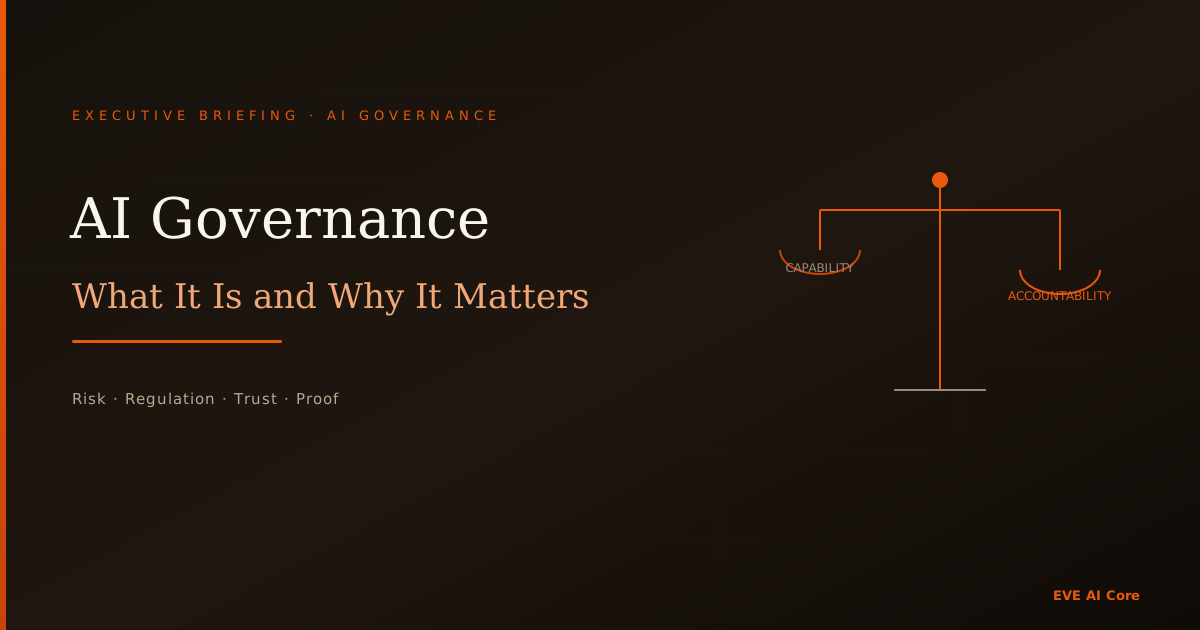
Every organization deploying AI eventually reaches the same fork in the road. On one side is speed: ship the model, automate the decision, capture the efficiency. On the other is a question that used to be theoretical and is now very real — if this system harms someone or breaks a rule, can we explain it, and can we prove we had it under control? AI governance is how you get to travel the first road without the second question becoming a crisis. This piece covers what it is in one paragraph, and then spends the rest on the part leaders care about most: why it matters.
What AI governance is, briefly
AI governance is the system of policies, controls, accountability, and evidence that an organization uses to direct what its AI does, keep it within legal and ethical limits, and prove after the fact that each decision followed the rules. Policy states the intent; controls enforce it at the moment of decision; evidence proves it happened. If you want the full breakdown of the components and frameworks, start with our primer: What Is AI Governance? The rest of this article is about the "why."
The value of governance is not measured on a good day. It is measured on the day something goes wrong and someone asks you to prove you had control.
Why AI governance matters: five forces converging
AI governance moved from a nice-to-have to a board-level priority because five pressures arrived at roughly the same time.
1. Regulation now has teeth
The EU AI Act is binding law with penalties that scale into the tens of millions of euros or a percentage of global turnover. In the U.S., the CFPB has made clear that a black-box model is not a legal excuse for failing to explain a denial, and bank examiners apply SR 11-7 model-risk expectations directly to AI. "We used AI" is not a defense anyone accepts anymore.
2. Liability is shifting to the deployer
When an AI system produces a discriminatory or harmful outcome, the organization that deployed it — not the model vendor — usually owns the consequence. Governance is how you demonstrate you exercised control, which is the difference between an isolated incident and a finding of negligence.
3. The decisions are consequential
AI is no longer confined to recommendations and chat. It approves credit, prices insurance, screens candidates, and flags patients. When a system's output changes someone's financial or medical life, the standard of accountability rises to match. Ungoverned automation at that scale is a liability multiplier.
4. Trust is now a purchasing criterion
Enterprise buyers, partners, and regulators increasingly ask vendors to show their AI governance, not describe it. A program you can prove is a competitive asset; one you can only assert is a procurement blocker. Legal and compliance teams are writing governance requirements directly into RFPs.
5. AI itself is opaque and drifts
Because models are probabilistic and change as data and versions change, "we validated it at launch" is no longer sufficient. A model that was fair last quarter can drift into bias after an update. Governance is the only thing that keeps assurance current instead of frozen at go-live.
The core question every one of these forces reduces to: when someone asks "why did your AI do that?", can you answer with proof — or only with a shrug? Governance is what turns the shrug into a signed record.
What it costs to get wrong
The downside of missing governance is not abstract. It shows up as regulatory fines and consent orders; as litigation where the absence of a defensible decision record becomes the story; as stalled AI programs frozen by a legal team that cannot get comfortable; and as reputational damage when a company cannot explain a decision that made the news. The 2019 Apple Card credit-limit controversy is the canonical example: the defense was essentially "the algorithm doesn't use gender," and it failed — not necessarily because the model was biased, but because the institution could not produce a trustworthy, per-applicant explanation. They had a fairness policy. They had no fairness evidence. That gap is what governance closes.
Why most governance programs still fail the test
Here is the uncomfortable part. Many organizations already have AI governance — on paper. They have a policy, a committee, a risk register, and a dashboard. And most of it will not survive an adversarial audit, for one reason: it stops at documentation. A policy that nothing enforces is a wish. A dashboard that observes violations after they happen produces a report, not a control. When the regulator asks for proof about one specific decision on one specific date, a general model card and a fairness statement do not answer it.
The three things that separate real governance from paper governance are enforcement (does something actually stop a non-compliant action?), evidence (is there a per-decision record?), and independent verifiability (can an outsider confirm it without trusting you?). Miss any one and the program looks tidy right up until someone competent pushes on it.
How EVE AI Core makes governance provable
This is the gap EVE AI Core exists to close. EVE is a deterministic governance control plane that turns policy into enforced, provable decisions.
Before an AI-influenced action executes, EVE CoreGuard evaluates it against your policy packs and returns ALLOW, MODIFY, BLOCK, or ESCALATE — deterministically, the same verdict for the same input every time, in under a millisecond. Because the check happens before execution, a non-compliant action is prevented, not merely logged after the damage is done.
Every decision produces a cryptographically signed, tamper-evident record. With EVE Proof, an auditor or regulator can verify that record offline, using only a public key — no access to your systems, no taking your word for it. That is what lets you answer "why did your AI do that?" with evidence instead of a shrug, and it is what maps a governance program onto the concrete obligations of the EU AI Act, SR 11-7, and the rest.
The practical payoff for a leadership team is simple: governance stops being a cost center that slows AI down and becomes the thing that lets you deploy AI faster — because legal, compliance, and the regulator can all see the control working, and prove it.
The bottom line
AI governance matters because the decisions AI now makes are consequential, the rules around them are enforceable, the liability lands on you, and trust has become something you must demonstrate rather than assert. What separates organizations that thrive with AI from those that stall is not whether they have a governance policy — almost everyone does — but whether they can prove it was followed. Build the enforcement and evidence layers, and AI governance shifts from a defensive obligation to a genuine advantage.